Run Distance Calculator [Takeoff Distance Calculator]
To calculate how far you’ve run, multiply your pace by the total time you spent running.
To calculate how far you’ve run, multiply your pace by the total time you spent running.
D = P × T
| Variable | Meaning |
|---|---|
| D | Distance (in km or miles) |
| P | Pace (speed per hour) |
| T | Time (in hours) |
Let’s say you head out for a jog. You check your watch. You know how long you ran. But one question lingers: how far did I run? That’s where the Run Distance Calculator comes in. You just plug in your pace and the time you ran, and it gives you the distance—fast, simple, and spot on.
Whether you’re running through your local park or training for a marathon in Singapore, New Zealand, or the UK, this tool adjusts to your pace and time. It’s helpful for casual joggers, serious runners, and anyone asking, “What’s my running distance?” or “How far did I run today?” No need to trace your route on Google Maps or rely on guesswork.
You can also use it as a running pace distance calculator or a way to cross-check data from apps like Map My Run. Whether you’re planning your next long run, checking your 12-minute run distance, or just staying active, this calculator gives you one clear answer: your true running distance.

To calculate win percentage, divide the total number of wins by the total number of attempts, then multiply the result by 100. The Win Percentage Calculator is a tool designed to measure success rates in games, sports, trading, and more. It calculates the percentage of victories relative to total attempts, making it easy to track…
To find how long it’ll take to lose weight, multiply the number of pounds you want to lose by 3,500, then divide by your daily calorie deficit. Formula: T = WL × 3500 ÷ CD Table of Variables Variable Meaning T Time (in days) WL Weight Loss Goal (in pounds) CD Daily Calorie Deficit What…
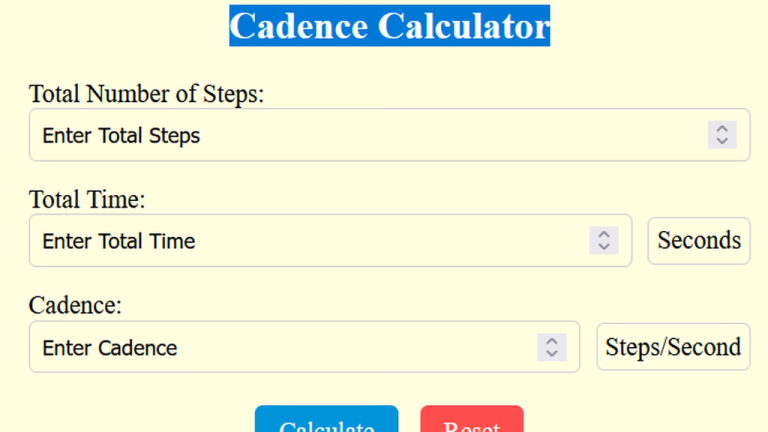
To calculate cadence, divide the number of steps, strides, or pedal revolutions by the time it takes to complete them. It shows how fast your feet or pedals move in steps or revolutions per minute. Formula: C = S / T Table of Variables Variable Meaning C Cadence (steps or RPM) S Steps, strides, or…
To find the NPV, divide the true negative rate by the sum of the true negative rate and the false negative rate. Formula: NPV = TNR ÷ (TNR + FNR) Table of Variables Variable Meaning NPV Negative Predictive Value TNR True Negative Rate FNR False Negative Rate What is a Negative Predictive Value Calculator |…
To find your RPE, divide your heart rate by 10. Formula: RPE = HR / 10 Table of Variables Variable Meaning RPE Rate of Perceived Exertion HR Heart Rate What is an RPE Calculator: Let’s measure the Rating of Perceived Exertion with this unique calculator Let’s say you’re running, your heart’s pounding, and you’re thinking,…