Water Mass Calculator {Mass Of Water Calculator 2025}
Multiply the volume of water by its density and divide by 1000 to get the mass in kilograms.
The Water Mass Calculator helps determine the mass of water based on its volume and density. This is particularly useful in fields such as physics, engineering, and environmental science.
Since the density of water is usually 1 g/cm³ (or 1000 kg/m³), this calculation is straightforward and reliable for everyday use.
Formula:
WM = VW ∗ DW / 1000
| Symbol | Meaning | Unit |
|---|---|---|
| WM | Water Mass | kilograms (kg) |
| VW | Volume of Water | liters (L) |
| DW | Density of Water | kg/m³ |
Solved Calculations
Example 1: Mass of 5 Liters of Water
| Step | Calculation |
|---|---|
| Volume of Water (VW) | 5 L |
| Density of Water (DW) | 1000 kg/m³ |
| Formula | WM = VW ∗ DW / 1000 |
| Result | WM = 5 ∗ 1000 / 1000 = 5 kg |
Example 2: Mass of 2.5 Liters of Water
| Step | Calculation |
|---|---|
| Volume of Water (VW) | 2.5 L |
| Density of Water (DW) | 1000 kg/m³ |
| Formula | WM = VW ∗ DW / 1000 |
| Result | WM = 2.5 ∗ 1000 / 1000 = 2.5 kg |
What is the Water Mass Calculator | Efficiently & Effortlessly Measure The Mass Of Water With This Mass Measuring Calculator:
The Water Mass Calculator is a practical tool intended to determine the mass of water based on its volume and density. This tool is essential for scientific calculations, engineering projects, and daily activities requiring precise water mass measurements.
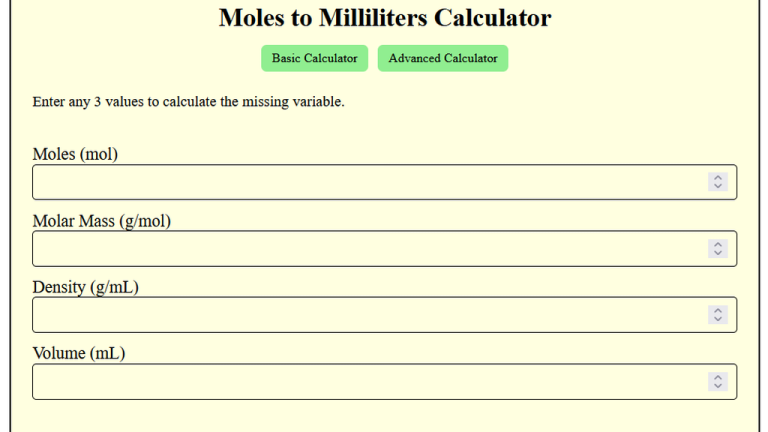
Using the calculator is straightforward. You input the volume of water (in liters, milliliters, or cubic meters) and, if necessary, adjust the density value for specific conditions like temperature. The tool then computes the water’s mass in kilograms or grams, ensuring accuracy for diverse applications.
This calculator is highly versatile and finds use in fields such as physics, chemistry, and environmental science. It helps scientists calculate water masses in experiments, engineers estimate water weights for structural designs, and individuals measure quantities for cooking or hydration tracking.
Additionally, it aids in understanding concepts like buoyancy, mass flow rates, and thermal capacity in water-related studies.
Final Words:
The Water Mass Calculator is an indispensable resource for precise water mass measurements. By offering accurate results and easy usability, it supports professionals and individuals in diverse tasks, from scientific research to everyday needs, ensuring efficiency and reliability.