Rug Size Calculator [Room, Floor, Tiles, Furniture, Dinning Table]
Add 8 inches to both the length and width of the desired rug area for a properly sized rug.
Add 8 inches to both the length and width of the desired rug area for a properly sized rug.
The Rug Size Calculator is a helpful tool for determining the ideal rug dimensions to suit your room and furniture layout. Whether decorating a living room, dining area, or bedroom, choosing the right rug size can significantly enhance your interior design.
RS = (L + 8), (W + 8)
| Variable | Meaning |
|---|---|
| RS | Rug Size (Length × Width) |
| L | Room Length (in inches) |
| W | Room Width (in inches) |
Example 1: Rug for a 10×12 ft room
| Step | Calculation | Result |
|---|---|---|
| Convert feet to inches | 10 × 12 × 12 | 120 × 144 |
| Add 8 inches to each | (120 + 8), (144 + 8) | (128, 152) |
| Final rug size | 128 × 152 in |
Example 2: Rug for a 16×16 ft living room
| Step | Calculation | Result |
|---|---|---|
| Convert feet to inches | 16 × 12 × 12 | 192 × 192 |
| Add 8 inches to each | (192 + 8), (192 + 8) | (200, 200) |
| Final rug size | 200 × 200 in |
The Rug Size Calculator is a practical tool to determine the ideal rug dimensions for any space, such as living rooms, bedrooms, or dining areas.
This calculator considers room size, furniture arrangement, and personal preferences to suggest suitable rug sizes, like 5×8 rugs, 8×10 rugs, or 9×12 rugs. It ensures that the chosen rug complements your décor while fitting perfectly within the room’s layout.
Whether you’re looking for a dining table rug size, a runner rug for hallways, or the correct size for a California king bed, this calculator simplifies decision-making. It also provides insights into rug placement, like centering under furniture or extending beyond a table for cohesive aesthetics.
From planning a cozy nursery with a 10×10 rug to styling a living room sectional with a rectangle or square rug, this tool adapts to various needs.
Ultimately, the Rug Size Calculator offers a straightforward solution for selecting rugs that enhance both the functionality and design of your spaces. With accurate measurements and helpful placement tips, it ensures stylish and well-fitted results every time.


To compute Energy Use Intensity (EUI), divide the total energy consumption (TETE) of a building by its total floor area (TFLATFLA). This metric is vital for evaluating a building’s energy efficiency. The EUI (Energy Use Intensity) Calculator is a practical tool for assessing the energy performance of buildings. EUI, expressed as energy consumption…

9 / 100 SEO Score To calculate calories per mile, multiply your weight in pounds by 0.75 and then by the distance you’ve walked or run in miles. There is not doubt that understanding how many calories you burn per mile is crucial for planning workouts or achieving weight loss goals. Generally, if you are…
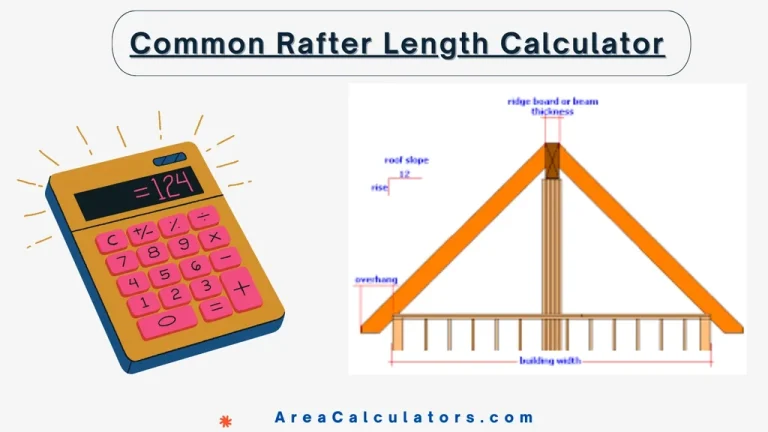
9 / 100 SEO Score To calculate the common rafter length, square the rise and run of the roof, then add these values together. Finally, take the square root of the sum to get the rafter length. A Common Rafter Length Calculator is a tool used to calculate the length of a rafter based on…
To calculate cycle time, divide the total runtime by the number of products or cycles produced. The Cycle Time Calculator is an essential tool for evaluating production efficiency. It measures the average time required to complete one cycle or produce a single unit in a manufacturing or business process. By understanding cycle time, businesses can…

To find mass from moles, multiply the number of moles by the molar mass. The Moles to Mass Calculator provides an efficient way to convert moles of a substance to its mass in grams. This calculation is vital in chemistry. It really assists you to find the mass of substances based on their molar quantity,…
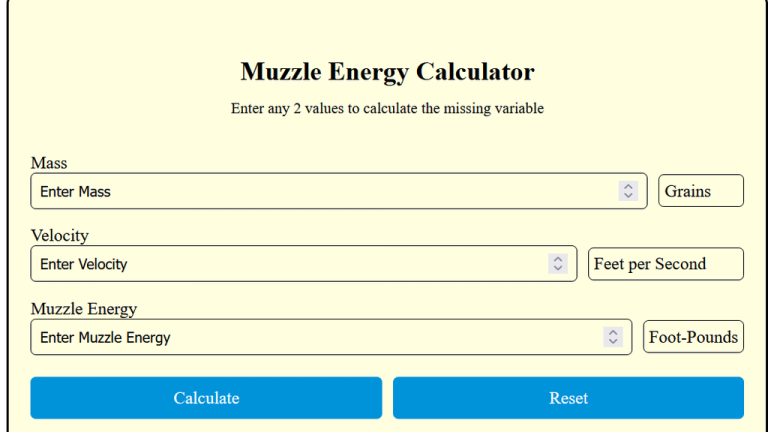
To calculate muzzle energy, use the formula KE=1/2∗m∗v2KE = 1/2 ∗ m ∗ v^2, where mm is the mass of the bullet and vv is its velocity. The Muzzle Energy Calculator is a vital tool for understanding the energy a projectile carries as it leaves the barrel of a firearm. This metric is important for…