BSA Calculator – Body Surface Area Calculator 2025
To find your body surface area, multiply your height by your weight, divide by 3600, and then take the square root of that number.
To find your body surface area, multiply your height by your weight, divide by 3600, and then take the square root of that number.
BSA = √(H × W ÷ 3600)
| Variable | Meaning |
|---|---|
| BSA | Body Surface Area (m²) |
| H | Height (in cm) |
| W | Weight (in kg) |
Think of your body as having a skin-sized footprint. That’s your body surface area (BSA) — and the BSA Calculator figures it out in seconds. It’s often used in medicine to decide drug dosages, especially in oncology and chemotherapy, where accuracy matters a lot. Instead of guessing, this tool gives you a safe and solid number.
There are different formulas like DuBois, Mosteller, and Halls, each slightly tweaking how height and weight are used. Whether you’re using a pediatric BSA calculator for kids or a version like the MDCalc or eviQ BSA calculator for clinical dosing, this tool adapts to your needs.
Planning treatment for psoriasis, burns, or atopic dermatitis? The BSA calculator also supports skin-related assessments. Need something for dogs or for chemopet dosing? It’s got that too. So whether you’re figuring out BSA for a 70kg adult, a child, or even a pet, this calculator takes the guesswork out of the equation.

To compute prorated PTO, divide the annual PTO by the total working days in a year and multiply by the remaining working days in the year. The Prorated PTO Calculator is a practical tool for measuring the amount of paid time off (PTO) an employee is entitled to when they join or leave an organization…
To find your anaerobic heart rate, subtract your age from 220, then multiply the result by 0.85. Formula: AHR = (220 – A) × 0.85 Table of Variables Variable Meaning AHR Anaerobic Heart Rate A Age (in years) What is an Anaerobic Heart Rate Calculator | Understanding Maximum Heart Rate & Training Zones With Cardiac…
To find your body density, subtract 0.0544 times the log of your skinfold sum (in mm) from 1.1422. Formula: D = 1.1422 – [0.0544 × log(skinfold sum in mm)] Table of Variables Variable Meaning D Body Density Skinfold Sum Total of skinfold measurements in millimeters What is a Body Density Calculator | Estimate Your…
To determine therapy productivity, divide the number of minutes a therapist spends in productive activities (MPMP) by the total minutes worked (MCMC) and multiply by 100. . The Therapy Productivity Calculator is an essential tool for therapists and healthcare administrators to measure efficiency in delivering care. It helps track how much of a therapist’s working…
To find your stride length, divide the distance you’ve walked or run (D) by the number of steps (S). Formula: SL = D / S Table of Variables Variable Meaning SL Stride Length D Distance S Number of Steps What is a Stride Length Calculator | Estimate The Stride Length Of Your Each Step: Picture…
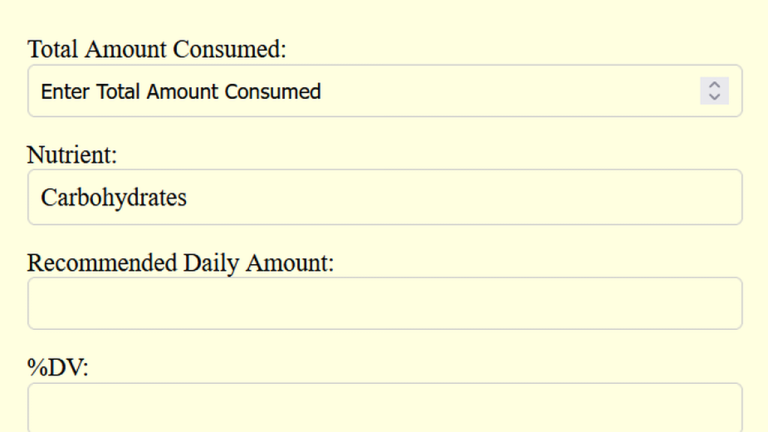
To find the %DV, divide the total content of the nutrient by its daily value, then multiply by 100. Formula: %DV = (TC ÷ DV) × 100 Table of Variables Variable Meaning %DV Percent Daily Value TC Total Content (in grams, mg, etc.) DV Recommended Daily Value What is a %DV Calculator | Find…