To calculate the backup capacity of a backpack, multiply the length, width, and height of the bag in centimeters. Then, divide the result by 1000 to convert the volume to liters.
The Backup Capacity Calculator is an easy-to-use tool that calculates the volume of a backpack in liters. By entering the bag’s length, width, and height, you can quickly determine how much it can hold. This tool is essential for choosing the right backpack size for school, travel, or daily use.
Formula:
Variable
Description
BC
Backup Capacity in liters
L
Length of the backpack (in cm)
W
Width of the backpack (in cm)
H
Height of the backpack (in cm)
Example Calculation:
Let’s say the Length (L) is 30 cm, Width (W) is 20 cm, and Height (H) is 50 cm.
A backup capacity calculator helps determine the storage capacity of a backpack in liters or cubic inches by calculating its internal volume based on the dimensions of the bag.
For example, a 20-liter backpack means the internal volume is about 20 liters, which is good for day trips or light packing. The same formula can be used to calculate the capacity of a 25-liter backpack by adjusting the dimensions accordingly.
The school backpack capacity calculator works similarly, helping students or parents choose an appropriate size. For larger items, like luggage, you can use the length x width x height method to calculate the volume in liters. These tools are essential for determining whether a backpack or luggage item fits specific needs, such as airline carry-on size limits or for daily use
To find the date 86 days from today, simply add 86 days to today’s date. 86 Days From Today Calculator Today’s Date Date 86 Days From Today Calculate Reset To predict 86 Days From Today is useful for planning future events, setting reminders, or scheduling deadlines. This quick calculation gives you an exact date in future….
10 / 100 SEO Score Enter the values in the required field to use our basic and advanced Awning Height calculator to get the results instantly! Choosing the right height for your awning is important for proper function and appearance. Most awnings are installed at a height between 8 to 12 feet, depending on the…
11 / 100 SEO Score Enter the values as they are required in fields to calculate with basic and advanced 48 Hours from Now Calculator. To know exact time 48 hours from now can be very important when you have to schedule meeting. This calculator is best for setting deadlines, planning events or just for…
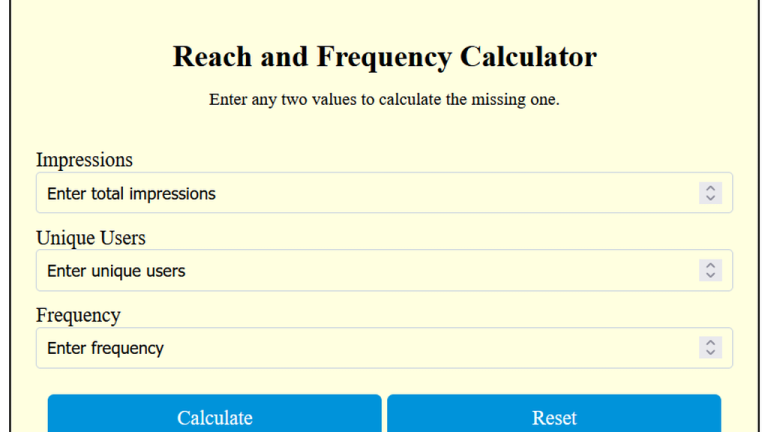
To calculate frequency, divide the total number of impressions (I) by the unique users (U) reached. The Reach and Frequency Calculator measures the effectiveness of advertising campaigns. Basically, reach refers to the number of unique users exposed to an ad, while frequency measures how often each user sees the ad. This calculation is essential for…
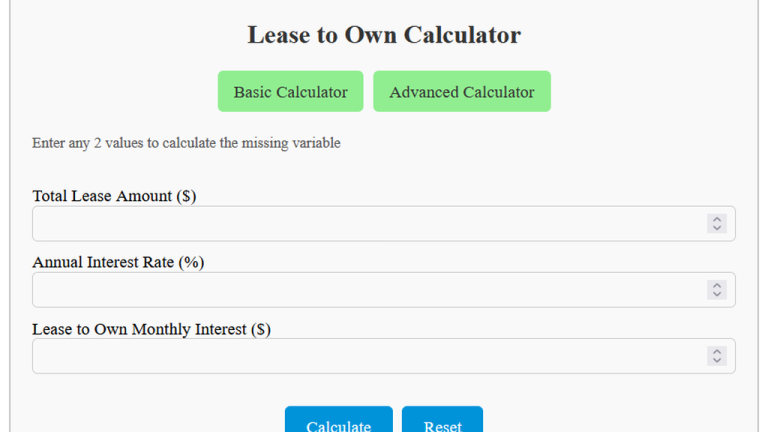
To calculate the monthly payment for a lease-to-own agreement, multiply the lease amount by the interest rate, divide by 100, and then divide by 12 to spread the cost over a year. The Lease-to-Own Calculator is an essential tool for estimating monthly payments on lease-to-own agreements. Whether you’re considering a car, home, or equipment, this…
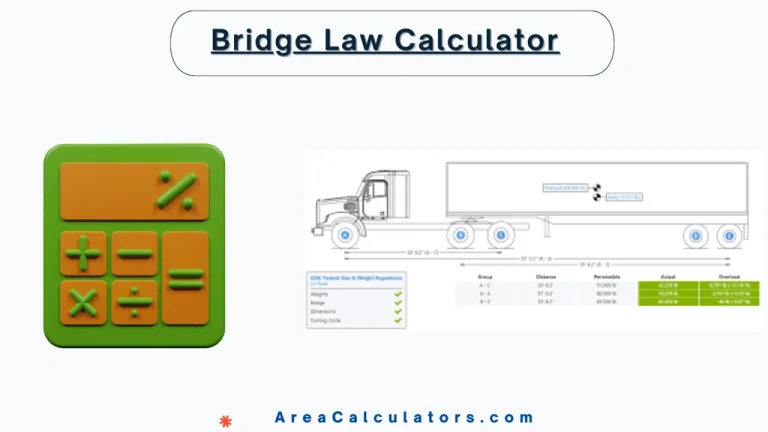
9 / 100 SEO Score To calculate the bridge weight, multiply the distance between axles (L) by the number of axles (N) and divide by (N – 1). Then add 12 times the number of axles and 36. Multiply the entire result by 500 to get the bridge weight. A Bridge Weight Calculator is essential…