Uneven Rectangular Area Calculator
Enter the values to use our basic and advanced Uneven Rectangular Area Calculator for instant calculation.
Uneven Rectangular Area Calculator
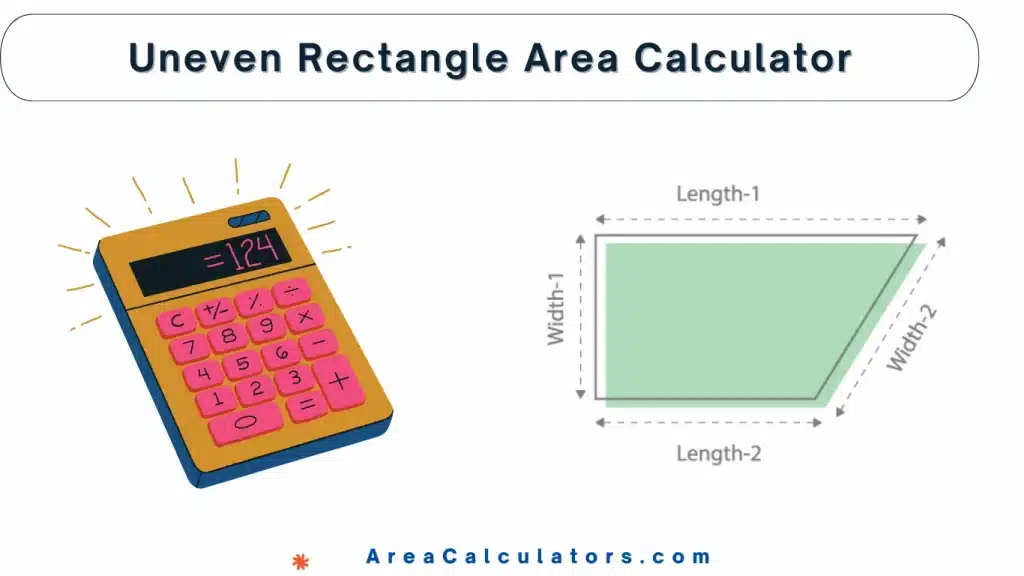
The Uneven Rectangular Area Calculator is a tool designed for calculating the area of rectangles with uneven sides. This tool is particularly useful in dealing with irregular spatial layouts, providing practical insights into complex geometric configurations.
Formula:
The formula is:
Variables:
Variable | Meaning |
|---|---|
Area | The total area of the uneven rectangle |
Side A Length | The length of side A of the rectangle |
Side B Length | The length of side B of the rectangle |
The sine of the angle between sides A and B in degrees or radians
|
First of all, measure the lengths of Side A and Side B of the uneven rectangle. Secondly, determine the angle between Side A and Side B. Thirdly, calculate the sine of the angle using a calculator. Finally, multiply 0.5 by the length of Side A, the length of Side B, and the sine of the angle to calculate the area.
Solved Calculations :
Example 1:
Given:
Side A Length = 10 meters
Side B Length = 12 meters
Angle between Sides A and B = 30°
Calculation | Instructions |
|---|---|
Step 1: Area = | Start with the formula. |
Step 2: Area = | Replace Side A Length with 10 meters, Side B Length with 12 meters, and angle with 30°. |
Step 3: Area = | Calculate |
Step 4: Area = | Multiply 10 by 12 to get 60. |
Step 5: Area = 15 square meters | Multiply all terms to get the final area. |
Answer:
The area is 15 square meters.
Example 2:
Given:
Side A Length = 8 meters
Side B Length = 10 meters
Angle between Sides A and B = 45°
Calculation | Instructions |
|---|---|
Step 1: Area = | Start with the formula. |
Step 2: Area = | Replace Side A Length with 8 meters, Side B Length with 10 meters, and angle with 45°. |
Step 3: Area = | Calculate |
Step 4: Area = | Multiply 8 by 10 to get 80. |
Step 5: Area = 28.28 square meters | Multiply all terms to get the final area. |
Answer:
The area is 28.28 square meters.
What is Uneven Rectangular Area ?
Calculating the area of an uneven rectangle or irregular quadrilateral can be more complex than a standard rectangle with equal sides. An Uneven Rectangular Area Calculator is designed to simplify this process. Unlike regular rectangles, where the area is simply the product of length and width, an uneven rectangle may have unequal sides, requiring a different approach.
One common method is to divide the shape into two triangles and calculate the area of each triangle using known side lengths and then add the areas together. This approach is especially useful when dealing with land plots, irregular fields, or construction projects.
Using an Uneven Rectangular Area Calculator can help ensure accuracy and efficiency in calculating areas with unequal sides. Whether for land measurement, construction, or landscaping, understanding how to calculate the area of an irregular shape ensures that projects stay on track and precise measurements are made.
Final Words:
The uneven Rectangular area calculation is important in fields like land surveying, construction, and geometry when dealing with non-standard rectangles. Understanding the area of such irregular shapes helps in planning, resource estimation, and construction projects.