
Rank And Nullity Calculator
To calculate the rank and nullity of a matrix, determine its rank (number of linearly independent rows or columns) and nullity (dimension of the null space). These values satisfy the Rank-Nullity Theorem.
To calculate the rank and nullity of a matrix, determine its rank (number of linearly independent rows or columns) and nullity (dimension of the null space). These values satisfy the Rank-Nullity Theorem.
The Rank and Nullity Calculator simplifies the calculation of rank and nullity for matrices. These concepts are fundamental in linear algebra and are used in solving systems of linear equations, determining linear transformations, and analyzing vector spaces.
The rank represents the number of independent rows or columns, while the nullity quantifies the solutions to the homogeneous equation. This calculator assists in verifying the Rank-Nullity Theorem, which states that the sum of rank and nullity equals the number of columns in the matrix.
| Variable | Description | Unit |
|---|---|---|
| Number of linearly independent rows/columns | Integer | |
| Dimension of the null space of the matrix | Integer | |
| Number of columns in the matrix | Integer |
Example 1:
| Step | Value | Explanation |
|---|---|---|
| Matrix | | Original matrix |
| Rank | Two linearly independent rows/columns | |
| Nullity | ||
| Verification | Rank-Nullity Theorem satisfied |
Example 2:
| Step | Value | Explanation |
|---|---|---|
| Matrix | | Original matrix (Identity matrix) |
| Rank | All rows/columns are linearly independent | |
| Nullity | ||
| Verification | Rank-Nullity Theorem satisfied |
The Rank and Nullity Calculator is a dynamic tool that calculates the rank and nullity of a given matrix, aiding in linear algebra applications.
This calculator is essential for determining the dimensions of a matrix’s row space and null space, which are vital in understanding its properties and transformations.
To use the calculator, input the matrix dimensions and values. The tool then applies the rank-nullity theorem, which states that the sum of the rank (dimension of column space) and nullity (dimension of null space) equals the number of columns.
For example, a 3×3 matrix with a rank of 2 will have a nullity of 1. This calculator simplifies tasks such as finding bases for column spaces and null spaces, or reducing a matrix to row echelon form.
Additionally, it supports students and professionals working on linear transformations, solving systems of linear equations, and studying the relationships between matrix dimensions.
To summarize, the Rank and Nullity Calculator streamlines matrix computations, making it a powerful resource for understanding matrix properties in linear algebra. It is particularly useful for academic studies, research, and professional applications.

To convert pounds (lbs) to grams per square meter (GSM), multiply the weight in pounds by 1.48. The Lbs to GSM Calculator is a simple tool to convert paper weight from pounds to GSM. This conversion is crucial in industries like printing, packaging, and textiles, where weight specifications are essential. It helps standardize measurements for…
13 / 100 SEO Score Enter the values of total percentage area, overall area, enclosed area to know total percentage area with our basic and advanced calculator The Open Area Percentage Calculator helps in the measurement of the amount of open space or slot area in a particular space. It is useful for planning and…
To calculate weight per square foot, divide the total weight by the total area. The Weight Per Square Foot Calculator is a practical tool used to determine the weight distribution over a given area. This calculation is commonly applied in construction, material science, and engineering to analyze loads, material weights, and floor strength. It is…
Multiply the number of COD Points by the USD conversion rate. The COD Points Calculator helps determine the cost of Call of Duty (COD) Points in USD, simplifying your budgeting for in-game purchases like skins, weapons, or upgrades. COD Points, the premium currency in games like Modern Warfare and Warzone, are essential for enhancing the…
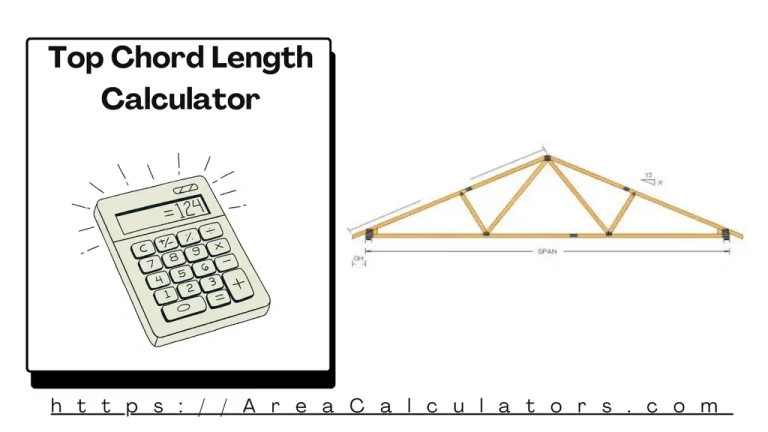
To calculate the Top Chord Length (TCL), divide the base by 2, square the result, add the square of the height, and take the square root of the sum. The Top Chord Length Calculator is a practical tool for engineers, architects, and construction professionals involved in roof truss design and analysis. This calculator simplifies the…
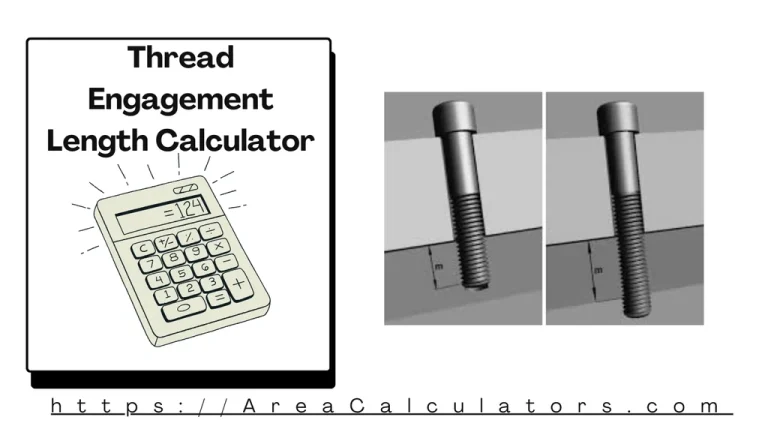
To calculate the Thread Engagement Length (Le), use the formula that considers the tensile stress area, thread pitch, and nominal diameter. This calculation helps ensure optimal strength and durability of threaded connections. The Thread Engagement Length Calculator is an essential tool for engineers, machinists, and designers working with fasteners and threaded connections. Proper thread engagement…