Molecules To Gram Calculator
To determine the weight in grams from molecules, multiply the number of molecules by the molar mass, then divide by Avogadro’s number. This gives the mass based on the molecular quantity.
To determine the weight in grams from molecules, multiply the number of molecules by the molar mass, then divide by Avogadro’s number. This gives the mass based on the molecular quantity.
The conversion of molecules to grams is critical in chemistry to accurately measure substances based on molecular amounts. If someone is working with complex compounds or simple elements, understanding this conversion aids in preparing precise quantities for experiments or industrial processes.
This calculation links molecular quantities to mass, allowing scientists and students to work in grams, a manageable and common unit for laboratory scales. Additionally, it connects the macroscopic and microscopic scales, as Avogadro’s number facilitates translating microscopic molecules to macroscopic masses.
| Variable | Description |
|---|---|
| Mass in grams | |
| Number of molecules | |
| Molar mass (g/mol) | |
| | Avogadro’s number ( ) |
Example 1:
| Step | Calculation |
|---|---|
| Number of Molecules (N) | 5.0×10²³ |
| Molar Mass (M) | 18 g/mol |
| Calculation | |
| Result | 14.94 g |
Answer: The mass is approximately 14.94 grams.
Example 2:
| Step | Calculation |
|---|---|
| Number of Molecules (N) | |
| Molar Mass (M) | 44 g/mol |
| Calculation | |
| Result | 146.07 g |
Answer: The mass is approximately 146.07 grams.
The Molecules to Gram Calculator is an excellent tool that is utilized for converting the number of molecules into grams. Yes, it is a common requirement in chemistry and scientific studies. To have the knowledge of these conversions is crucial for calculating the precise mass of a substance based on its molecular count.
By entering the number of molecules and the molar mass, this calculator supports in accurately translating molecular quantities into measurable grams.
Moreover, to perform the conversion, the calculator uses the molar mass of the substance to link molecule counts with weight in grams.
For example, a specified number of molecules of a substance with a known molar mass will be instantly converted, streamlining calculations for lab work or academic assignments. This tool oversimplifies the process, making it efficient and error-free.
On a final note, the Molecules to Gram Calculator is essential for precise conversions in chemistry, saving time and supporting accuracy in scientific tasks.

An exponent calculation involves multiplying the base X by itself n times, represented as Xn=YX^n = Y. The Exponent Calculator simplifies the process of solving exponential expressions. It helps calculate powers of numbers, fractions, or variables and supports both positive and negative exponents. This tool is widely used in algebra, scientific computations, and engineering applications…
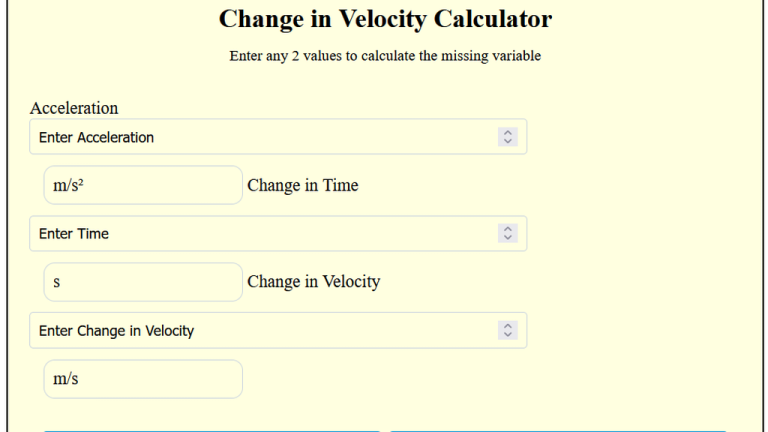
To find the change in velocity, multiply acceleration (a) by the change in time (ΔT). The Change in Velocity Calculator provides a straightforward way to calculate the difference in velocity over a specified time interval, given the acceleration. This tool is invaluable in physics and engineering. In fact, understanding the shifts in velocity due to…
To calculate the weight of laminated veneer lumber (LVL), multiply the length (L), width (W), and thickness (T) of the LVL in inches, divide by 12, and then multiply by 41 to estimate the weight in pounds. The LVL (Laminated Veneer Lumber) Weight Calculator is a handy tool for estimating the weight of LVL beams,…
To convert milligrams (mg) to teaspoons (tsp), divide the amount in mg by 5000. This conversion assumes a general density, as specific substance densities vary. The Mg to Tsp Calculator is a practical tool for converting milligrams to teaspoons, providing an approximate measurement for common ingredients or medicines. Given that, the teaspoons are often used…
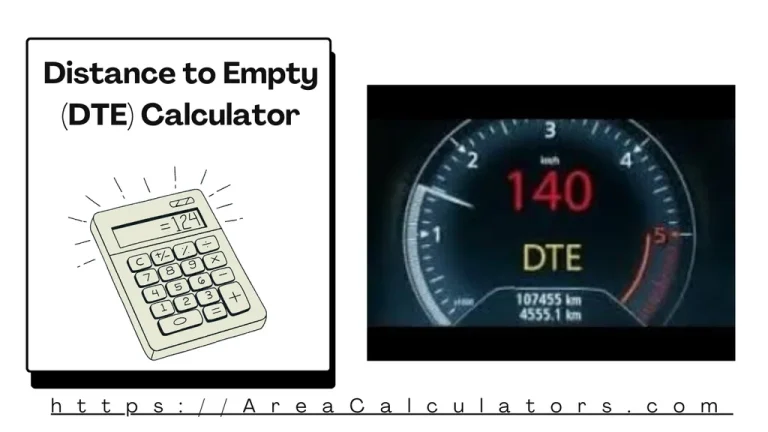
Multiply the remaining fuel in gallons by the average miles per gallon (MPG) to estimate the distance to empty. The Distance to Empty (DTE) Calculator helps drivers estimate how far their vehicle can travel with the remaining fuel. This is particularly useful for planning refueling stops during long trips or managing fuel levels efficiently in…
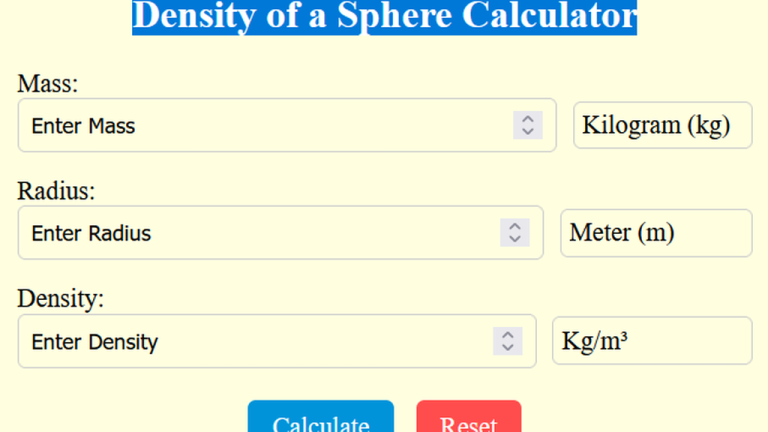
To find the density of a sphere, divide its mass (mm) by its volume, which is calculated using the formula for the volume of a sphere (43πr3\frac{4}{3} \pi r^3). The Density of a Sphere Calculator computes the density of a spherical object by using its mass and radius. Density is a fundamental property that measures…