ml to mg Calculator
To convert milliliters (ml) to milligrams (mg), multiply the volume in ml by 1000 and then by the substance’s density (d) in g/ml. This gives the mass of the substance in milligrams.
The ml to mg Calculator is a useful tool for converting liquid volumes (ml) to mass (mg) based on density. This is particularly helpful in fields like medicine, chemistry, and cooking. Since mg measures mass and ml measures volume, the density factor bridges these units.
This tool simplifies dosage calculations and helps users convert liquid volumes into milligrams for accurate results, making it essential in applications requiring precise measurement conversions.
Formula
The formula for ml to mg (mg) is:
| Variable | Description |
|---|---|
| Milligrams | |
| Milliliters (volume) | |
| Density in grams per milliliter (g/ml) |
Solved Calculations
Example 1:
Convert 2 ml of a substance with a density of 1.5 g/ml to mg.
| Step | Calculation |
|---|---|
| 1. | |
| 2. | |
Answer: 3000 mg
Example 2:
Convert 0.5 ml of a substance with a density of 0.8 g/ml to mg.
| Step | Calculation |
|---|---|
| 1. | |
| 2. | |
Answer: 400 mg
What is an ml to mg Calculator?
The ml to mg Calculator is a user-friendly tool for converting milliliters (ml) to milligrams (mg). This tool is usually serviceable in medicine, nutrition, and chemistry. Indeed, the precise measurements are very necessary in these fields.
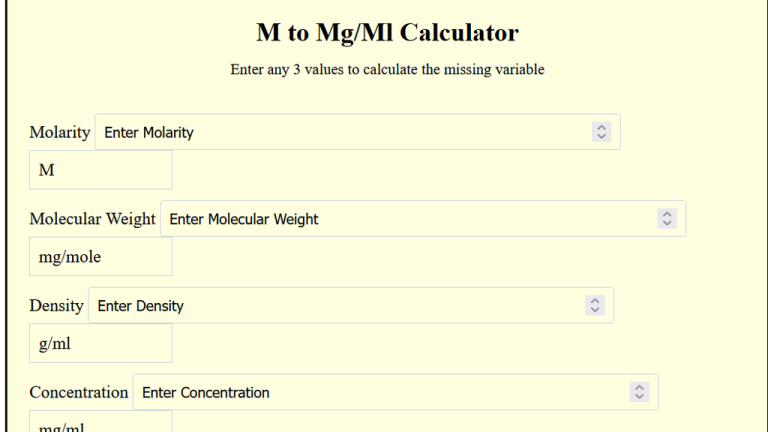
To make things easier, this conversion depends on the concentration of the substance, typically indicated as mg/ml. For instance, converting 5 ml of a medication with a concentration of 10 mg/ml results in a dose of 50 mg.
In truth, this calculator is invaluable for accurate dosing, as different medications or solutions have varying mg/ml concentrations. By inputting the volume in ml and concentration, it provides an instant conversion, saving time and ensuring precise measurements. This is particularly helpful for tasks like calculating dosages or adjusting medication levels in syringes.
Final Words:
In a nutshell, the ml to mg Calculator simplifies the conversion process, ensuring accurate measurements in healthcare, pharmaceuticals, and laboratory work, making it essential for anyone handling liquid substances with specific concentrations.