Calories Burned Pumping Calculator
10
/ 100
SEO Score
Formula:
The Calories Burned Pumping Calculator uses the following formula:
Calories Burned = (MET * 3.5 * Weight in kg) / 200 * Duration in minutes
The Calories Burned Pumping Calculator uses the following formula:
Calories Burned = (MET * 3.5 * Weight in kg) / 200 * Duration in minutes

To determine Time-Weighted Average (TWA) noise exposure, start by calculating the noise dose (D) using measured sound levels and exposure times. Then, use the TWA formula to estimate the average noise level over an 8-hour workday. The TWA (Noise Exposure) Calculator helps assess the average noise levels workers are exposed to during an 8-hour work…
To determine the rolling offset, calculate the square root of the sum of the squares of the horizontal, vertical, and diagonal offset components. The Rolling Offset Calculator simplifies the calculation of rolling offsets, which are crucial in piping and conduit systems. This tool is particularly useful in plumbing, HVAC, and construction projects where precise measurements…
Multiply the length, width, thickness, and density of the MDF board to calculate its weight. The Medium Density Fiberboard (MDF) Weight Calculator is a practical tool to estimate the weight of MDF panels used in furniture, construction, and other applications. MDF is a versatile material known for its uniformity and smooth surface, making it a…
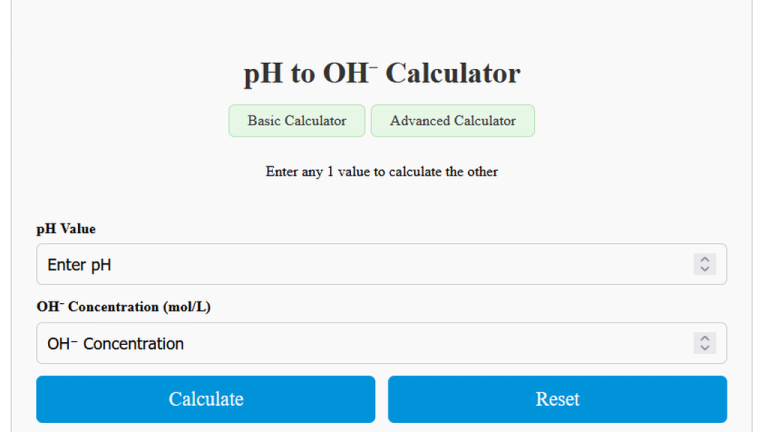
To calculate the hydroxide ion concentration (OH−) from pH, use the formula [OH−]=10−14+pH[OH−] = 10^{−14 + pH}. The Ph to Oh- Calculator allows you to calculate the concentration of hydroxide ions ([OH−][OH−][OH−]) based on the given pH value. In essence, the pH scale measures the acidity or alkalinity of a solution, while the OH− concentration…
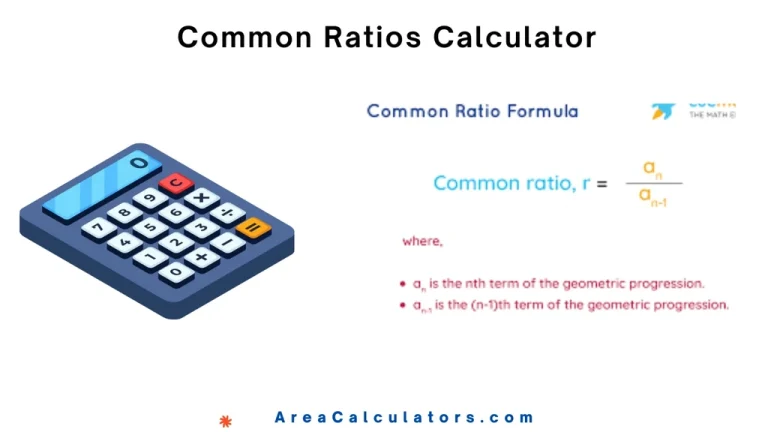
To find the common ratio in a geometric sequence, divide any term by its preceding term. This helps identify the consistent multiplier between terms, simplifying sequence analysis. The Common Ratios Calculator is created to calculate the multiplier, or common ratio, between consecutive terms in a geometric sequence. Without any shadow of doubt, this tool is…
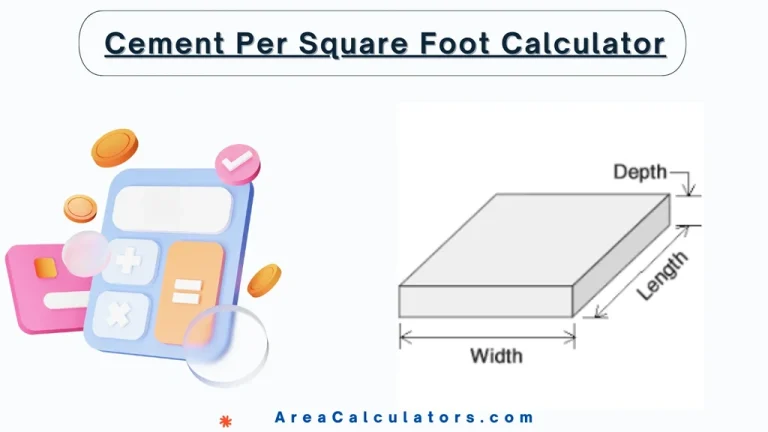
9 / 100 SEO Score First, determine the area in square feet of your slab. Then, input the thickness of the slab in inches. Multiply the area by the thickness (converted to feet) and divide by 27 to get the total amount of cement required in cubic yards. A Cement Per Square Foot Calculator is…