
Basis Point to Percentage Calculator – Basis Point Calculator 2025
Multiply the number of basis points (BP) by 0.0001 to convert them into a percentage.
Multiply the number of basis points (BP) by 0.0001 to convert them into a percentage.
The Basis Point to Percentage Calculator simplifies the conversion of basis points into percentages. Basis points (bps) are commonly used in finance to represent changes in interest rates, yields, and other financial metrics.
P = BP ∗ 0.0001
| Variable | Description | Unit |
|---|---|---|
| P | Percentage equivalent | Percentage (%) |
| BP | Basis points | Points |
Example 1: Converting 25 Basis Points to Percentage
| Step | Value | Explanation |
|---|---|---|
| Basis points (BP) | 25 | Number of basis points |
| Multiply BP by 0.0001 | Apply the conversion formula | |
| Result | 0.0025 or 0.25% | Percentage equivalent |
Example 2: Converting 100 Basis Points to Percentage
| Step | Value | Explanation |
|---|---|---|
| Basis points (BP) | 100 | Number of basis points |
| Multiply BP by 0.0001 | Apply the conversion formula | |
| Result | 0.01 or 1% | Percentage equivalent |
The Basis Point to Percentage Calculator is a straightforward tool. It has been designed to convert basis points (bps) into percentages and vice versa. Basis points are commonly used in finance and investments to express changes in interest rates, fees, or other percentages. One basis point equals 0.01%, making conversions critical for accurate financial calculations.
This calculator simplifies the process by requiring only the input of the basis point value to instantly provide the corresponding percentage. It is particularly helpful for financial analysts, investors, and anyone dealing with precise percentage changes in interest rates or investment returns.
By offering quick and accurate conversions, the tool ensures clarity in financial decision-making, enabling users to interpret and communicate rate changes more effectively. Whether you’re evaluating loan rates or investment fees, this calculator provides essential support for financial tasks.
In summary, the Basis Point to Percentage Calculator offers an efficient way to handle conversions between basis points and percentages, ensuring accuracy in financial analysis and communication. Its simplicity and reliability make it an invaluable tool for both professionals and individuals managing financial data.

To calculate pipe ovality, determine the maximum and minimum outside diameters (OD) of the pipe and use the nominal OD in the formula. This ensures precision in assessing pipe deformation. The Pipe Ovality Calculator is an essential tool for engineers and quality inspectors in the pipeline and construction industries. Ovality, the measure of deviation from…
10 / 100 SEO Score To check if a triangle follows the 3, 4, 5 rule, square the lengths of the two shorter sides and add them together. If the sum equals the square of the hypotenuse, the triangle is a right triangle. The 3, 4, 5 rule is a simple and commonly used method…

To find club head speed, divide the ball speed by 1.5. The Club Head Speed Calculator is a savior for the golfers who are looking to understand their swing dynamics better. Club head speed, calculated from ball speed, plays a key role in calculating distance and control in golf. This metric is valuable for adjusting…
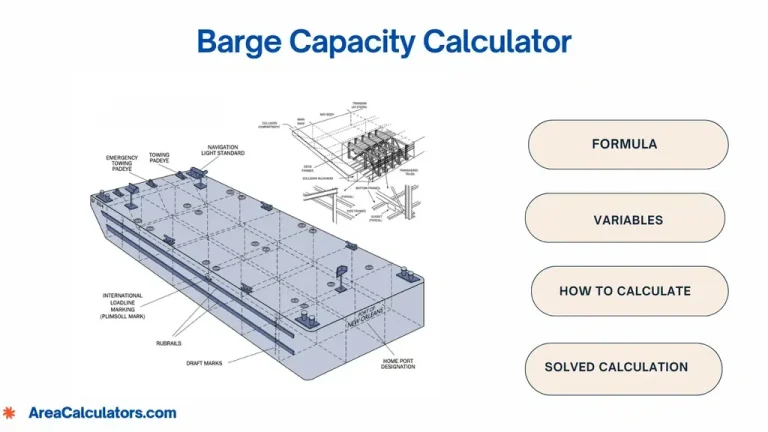
10 / 100 SEO Score Enter the values of length, width, depth, cargo capacity to calculate the barge capacity with our basic and advanced barge capacity calculator The Barge Capacity Calculator is useful to know barge sizes and capacities, metrics, boat barge etc. Barges play a crucial role in transporting goods along rivers, canals, and…
To calculate nationality percentage, sum the percentages of inherited ethnicities and divide by the total contributors. The Nationality Percentage Calculator estimates your nationality or ethnic background as a percentage. It is helpful for those exploring ancestry, mixed heritage, or genetic makeup. By combining inherited percentages from both parents or other sources, this tool offers a…
To find total pay with a shift differential, multiply the base pay rate (BP) by hours worked (HW) and add the product of the base pay, differential rate (DR), and hours worked. The Shift Differential Calculator is specially made for the employees and employers who need to determine adjusted wages for hours worked outside regular…