Amps Per Phase Calculator – Power, Voltage, Current, Watts

9 / 100 SEO Score

First, multiply the power in kW by 1000. Then, divide by the product of square root of 3, voltage, and power factor to find the amps per phase.

Amps Per Kw Calculator

Enter any 2 values to calculate the missing variable

An Amps Per Phase Calculator helps you determine the current in each phase of a 3-phase system based on power, voltage, and power factor. This tool is useful for balancing electrical loads and ensuring proper system performance.

Formula:

APP=P×10003×V×PFAPP = \frac{P \times 1000}{\sqrt{3} \times V \times PF}

Where:

VariableMeaning
APPAmps per phase
PPower in kilowatts (kW)
VVoltage (V)
PFPower factor

Example Calculation:

Let’s say the power (P) is 50 kW, the voltage (V) is 400V, and the power factor (PF) is 0.9.

APP=50×10003×400×0.9=50000692.82=72.18amps per phaseAPP = \frac{50 \times 1000}{\sqrt{3} \times 400 \times 0.9} = \frac{50000}{692.82} = 72.18 \, \text{amps per phase}

StepCalculation
Power (P)50 kW
Voltage (V)400V
Power Factor (PF)0.9
Multiply P by 100050×1000=5000050 \times 1000 = 50000
Multiply 3×V×PF\sqrt{3} \times V \times PF3×400×0.9=692.82\sqrt{3} \times 400 \times 0.9 = 692.82
Divide power by result50000692.82=72.18\frac{50000}{692.82} = 72.18 amps per phase

Answer: The current is 72.18 amps per phase.

What is Amps Per Phase | Instantly Measure Amperes Per Phase, 3 Phase, Harness Power, Volt, Watts, Current with Amperage Calculator 2025:

The amps per phase calculation determines the current flowing through each phase of a 3-phase power system. This formula is essential for balancing electrical loads and ensuring the safe operation of electrical systems. By calculating amps per phase, you can estimate the current based on the power, voltage, and power factor of the system.

This is especially helpful in determining how many amps are required in a 3-phase system, which is commonly used in industrial and commercial applications.

For example, this calculator helps answer questions like “how do you calculate amps per phase” or “what is the maximum amps per phase”, providing insights for electrical load calculations. You can also use this tool for kW to amps conversions and phase current calculations.

Similar Posts

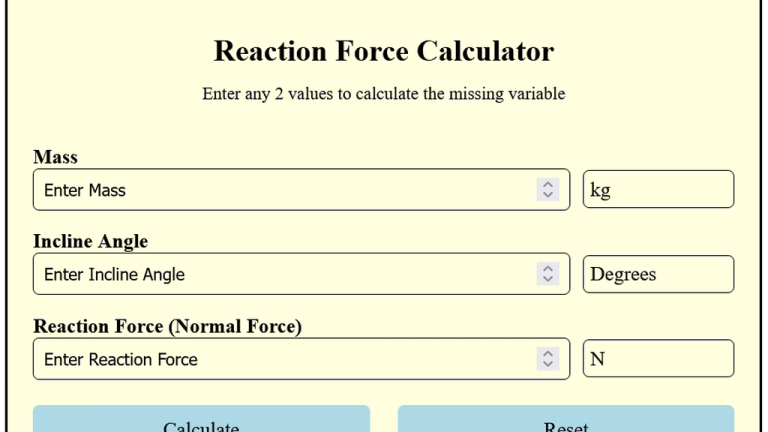
  • Reaction Force Calculator

    To calculate the reaction force, multiply the object’s mass (m) by gravitational acceleration (g) and the cosine of the angle of inclination (cos(x)). The Reaction Force Calculator can support you to calculate the reaction force that is acting on a beam or an object in physics and engineering problems. It is especially useful for analyzing…

  • System Reliability Calculator

    System reliability is calculated by multiplying the reliability of each component in a series system. Each component’s reliability is derived by subtracting its failure rate from 1. The System Reliability Calculator is a tool designed to help determine the overall reliability of a system comprising multiple components. It is essential in industries like manufacturing, IT,…

  • 47 Days From Today

    To determine the date 47 days from today, add 47 days to the current date. If needed, exclude weekends or holidays for business day calculations. 47 Days From Today Calculator Today’s Date Date 47 Days From Today Calculate Reset The 47 Days From Today Calculator is a simple yet practical tool for planning and scheduling….

  • Line Capacity Calculator

    To calculate line capacity, divide 1440 by the sum of cycle time (T) and setup time (t), then multiply the result by efficiency (E). Line Capacity Calculator Enter any 3 values to calculate the missing variable Time of Slowest Running Train Seconds Minutes Hours Block Time Seconds Minutes Hours Efficiency Factor Line Capacity (Trains /…

  • B Value Calculator

    10 / 100 SEO Score To calculate the B value, multiply the two temperatures (T1 and T2), then divide by the product of the natural logarithm of the ratio of resistances (R1/R2) and the difference in the inverse temperatures (1/T1 – 1/T2). B Value Calculator Enter all values to calculate the B Value Resistance at…