
AC ↔ DC Voltage Calculator – Alternating Current To Direct Current
To calculate DC voltage from AC voltage, multiply the AC voltage by 0.636. This formula applies to converting RMS AC voltage to its approximate DC equivalent in rectified circuits.
To calculate DC voltage from AC voltage, multiply the AC voltage by 0.636. This formula applies to converting RMS AC voltage to its approximate DC equivalent in rectified circuits.
The AC ↔ DC Voltage Calculator simplifies the conversion between alternating current (AC) and direct current (DC) voltages. Undoubtedly, it is a vital task in electrical engineering and electronics. It’s particularly helpful for designing circuits, testing power supplies, or understanding rectification processes.
Whether you’re calculating the DC equivalent of a given AC voltage or analyzing the relationship between these two types of current, this calculator ensures accuracy and efficiency. Ideal for professionals and hobbyists alike, it streamlines complex calculations with ease.
Vdc = Vac ∗ 0.636
| Variable | Description |
|---|---|
| Vdc | Direct current (DC) voltage |
| Vac | Alternating current (AC) voltage |
Example 1:
| Step | Value |
|---|---|
| AC Voltage (Vac) | 120V |
| Formula Used | Vdc = Vac ∗ 0.636 |
| Result | Vdc = 120 ∗ 0.636 = 76.32V |
| Answer | 76.32V |
Example 2:
| Step | Value |
|---|---|
| AC Voltage (Vac) | 230V |
| Formula Used | Vdc = Vac ∗ 0.636 |
| Result | Vdc = 230 ∗ 0.636 = 146.28V |
| Answer | 146.28V |
The AC ↔ DC Voltage Calculator is a versatile tool. This accessory is perfectly suitable for converting the alternating current (AC) voltage to direct current (DC) voltage and vice versa. It is chiefly beneficial for electrical engineering, solar energy systems, and circuit design. By using this calculator, users can quickly determine voltage equivalencies, ensuring precise power management.
This tool simplifies calculations such as AC to DC conversion, DC to AC voltage conversion, and assessing the relationship between root mean square (RMS) and peak voltage. Whether you’re working on a 12V DC to 240V AC system or calculating DC voltage drop across a resistor, the calculator provides reliable results for both single-phase and three-phase circuits.
Additionally, it assists in understanding formulas like the AC-to-DC conversion ratio or the DC equivalent of AC voltage, helping professionals optimize power systems and troubleshoot effectively.
In summary, the AC ↔ DC Voltage Calculator is an indispensable tool for accurate voltage conversions. It enhances efficiency and reliability in electrical calculations, making it ideal for professionals and hobbyists working with power systems and electrical devices.

To find the date 105 days from today, simply add 105 days to the current date. 105 Days From Today Calculator Today’s Date Date 105 Days From Today Calculate Reset The “105 Days From Today” Calculator supports you to measure the exact date that will be 105 days in the future. In other words, it…

To determine the correct door header size, use the span of the opening and refer to a header size chart. Each header type (e.g., 4×4, 4×6) has a specific span limit, ensuring structural stability for load-bearing or non-load-bearing walls. The Door Header Size Calculator simplifies the process of selecting an appropriate header size for various…

14 / 100 SEO Score To calculate the limit of a multivariable function as the variables approach specific values, evaluate the function’s behavior as each variable approaches its corresponding value. This involves analyzing how the function behaves from multiple directions in the domain. Multivariable Limit Calculator Enter the function and the point to calculate the…

To convert milligrams (mg) to teaspoons (tsp), divide the amount in mg by 5000. This conversion assumes a general density, as specific substance densities vary. The Mg to Tsp Calculator is a practical tool for converting milligrams to teaspoons, providing an approximate measurement for common ingredients or medicines. Given that, the teaspoons are often used…
To calculate torque (T) from horsepower (HP) and RPM, divide HP by (RPM / 5252). HP to Torque Calculator Enter any 2 values to calculate the missing variable HP HP kW RPM Torque lb-ft N-m Calculate Reset The HP ↔️ Torque Calculator is essential for automotive enthusiasts, engineers, and mechanics. Because, it enables the quick…
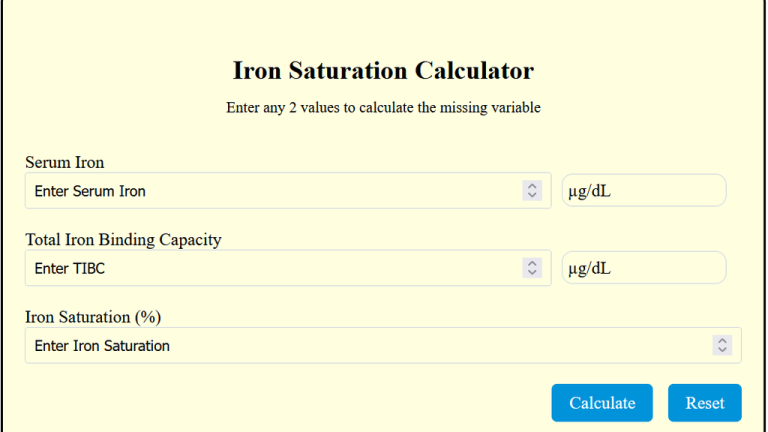
To calculate iron saturation, divide serum iron (SI) by total iron-binding capacity (TIBC), then multiply the result by 100 to express it as a percentage. The Iron Saturation Calculator is a useful tool for assessing iron levels in the body. It calculates the percentage of transferrin, a protein that binds and transports iron, currently saturated…